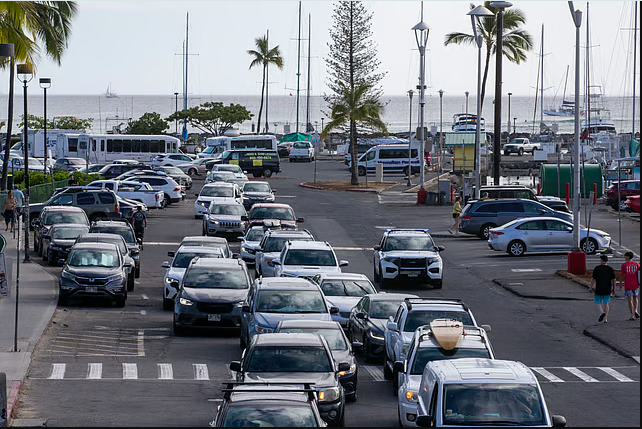
ANCHORAGE, Alaska A powerful undersea earthquake near Russia’s Kamchatka Peninsula triggered a tsunami that struck parts of Alaska on Tuesday evening, setting off a wave of emergency preparations along the U.S. West Coast as authorities released projected arrival times for potentially dangerous surges.
The magnitude 8.8 quake, which struck at a depth of approximately 11 miles beneath the Pacific Ocean, unleashed immediate tsunami activity throughout the North Pacific region. Alaska’s Aleutian Islands, closest to the epicenter, were among the first to be impacted. The National Tsunami Warning Center (NTWC) issued full tsunami warnings for coastal regions including Adak, Shemya, and Attu.
Initial waves, while relatively modest in height some under one foot reached parts of the Aleutian chain just after 5:00 p.m. local time, with officials cautioning that the first wave is rarely the most destructive.
“Do not be deceived by early wave sizes,” warned NTWC Director Thomas Mueller. “Stronger, more dangerous surges can follow hours later.”
West Coast on Alert
As the tsunami propagated across the Pacific, tsunami advisories and watches were issued from Washington to Southern California. Coastal residents were urged to stay off beaches, piers, and marinas. Emergency alerts have been activated in Seattle, San Francisco, Los Angeles, and San Diego.
According to NTWC’s latest bulletin, estimated wave arrival times include:
- Astoria, OR / Port Angeles, WA – ~11:40 p.m. PT
- San Francisco, CA – ~12:40 a.m. PT
- Santa Barbara to San Diego, CA – Between 12:55–1:10 a.m. PT
Forecast models suggest the potential for waves between 1 to 3 meters (up to 10 feet) in certain vulnerable locations such as Crescent City, CA, a city historically hit hard by tsunamis.
“We are treating this with the utmost seriousness,” said Lt. Gov. Eleni Kounalakis of California, who urged residents to follow evacuation instructions and remain alert overnight.
Hawaii Also in the Path
In Hawaii, waves began reaching parts of the archipelago around 7:20 p.m. HST, prompting a full evacuation order for low-lying areas in Honolulu. Early reports showed water surges of up to 3 feet on some shores, with harbors experiencing powerful currents.
No Immediate Reports of Major Damage
As of this writing, no significant structural damage or fatalities have been reported in Alaska or along the Pacific coast. However, officials warned that damage assessments would continue as tides fluctuate and waves continue to arrive over several hours.
Seismologists believe the quake occurred along the Kuril-Kamchatka Trench, a highly active subduction zone prone to powerful seismic events. The U.S. Geological Survey (USGS) confirmed multiple strong aftershocks, some exceeding magnitude 6.0.
Preparedness and Public Safety
Authorities emphasized that tsunami advisories can remain in effect for hours or even days, and the public should not return to coastal areas until an official “all clear” is given.
“This is not a drill,” said FEMA spokesperson Carla Vega. “We are facing a real and potentially destructive event that could evolve overnight.”
Evacuation centers were opened across Alaska and key points along the Pacific Coast. Public transportation agencies rerouted buses to assist in moving residents away from risk zones.
What Comes Next
Monitoring will continue through the night as emergency agencies coordinate with the NOAA, U.S. Coast Guard, and local officials. Meanwhile, coastal cities are expected to update residents on school closures, travel disruptions, and safety protocols by Wednesday morning.